
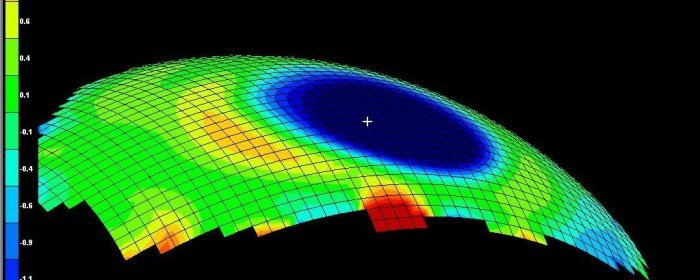
New hyperopic overnight orthokeratology contact lenses were tested over a 7 day period in an effort to restore near vision in prebyopic patients without glasses. Presbyopia is an age related condition which affects people and normally appears around the age of 40 leading to the need for reading glasses. Results showed that this was sufficient to provide functional correction of near vision. Lack of change in binocular distance sowed that hyperopic OK offers a viable option for providing monovision correction in emmetropic presbyopia. read more
This Study was a featured piece of research in the October 2012 issue of investigative Opthomalogy and Visual Science. It is a key piece of research into overnight contact lenses for children and it concludes that the children wearing overnight ortho-k lenses had a slower increase in eye elongation by 43% compared with that of children wearing single-vision prescription glasses. The development of myopia in younger children tends to be much faster and these children the study concludes, may benefit most from early myopia treatment using overnight ortho-k lenses. The study was carried out in Hong Kong where the rise of myopia in children is highest with around 90% of school leavers in asian cities suffreing from myopia. read more
The SMART Study is the largest clinical investigation so far into whether Overnight Vision Correction (OVC) can stop the progression of short-sightedness in children once they start wearing i-GO OVC lenses. Presented at the Global Speciality Lens Conference January 2011. read more
This Hong Kong Study reviewed the clinical records of over 200 short-sighted children attending a local opticians over a prior period of seven years and for a sub-group of 70 children divided into those who had undergone Overnight Vision Correction (OVC) treatment with an average commencement age of 9 and those who had worn glasses with an average commencement age of 10. read more
This Japanese study compared 92 short-sighted children with an average age of 12 and an average prescription of -2.50D who were divided into two groups – one undertaking Overnight Vision Correction (OVC) treatment and the other wearing spectacles – in terms of how their short-sightedness had developed over a two year period following commencement of treatment. read more
Jeffrey J. Walline & Eef van der Worp, two leading researchers and practitioners in the field of controlling short-sightedness review the evidence available from various clinical studies which have assessed how effective Overnight Vision Correction (OVC) is in slowing down or halting the progression short-sightedness in children.
read more
This US study compared 28 short-sighted children aged 8 to 11 who had undergone Overnight Vision Correction (OVC) treatment and subsequently worn overnight ortho-k corrective contact lenses for two years against an equivalent group wearing conventional soft contact lenses. read more
After reading the outcomes of the LORIC, CRAYON and SMART studies, two US opticians then undertook their own investigation into whether Overnight Vision Correction (OVC) can slow down or halt the further development of short-sightedness once patients are fitted with overnight ortho-k corrective contact lenses. read more